Getty Images
On May 17, while delivering a graduation speech to cadets at the Coast Guard Academy in New London, Connecticut, a scandal-plagued President Donald Trump took the opportunity to complain, yet again, about the news media. No leader in history, he said, has been treated as unfairly as he has been. Shortly thereafter, when the graduates presented Trump with a ceremonial sword, a live mic picked up Homeland Security chief John F. Kelly telling the president, “Use that on the press, sir!”
Kelly was presumably joking, but the press isn’t laughing. Presidents have complained bitterly about reporters since George Washington (“infamous scribblers“), but Trump has gone after the media with a venom unmatched by any modern president—including Richard Nixon. At campaign rallies, Trump herded reporters into pens, where they served as rhetorical cannon fodder, and things only got worse after the election. Prior to November 8, the media were “scum” and “disgusting.” Afterward, they became the “enemy of the American people.” (Even Nixon never went that far, noted reporter Carl Bernstein of Watergate fame. Nixon did refer to the press as “the enemy,” but only in private and without “the American people” part—an important distinction for students of authoritarianism.)
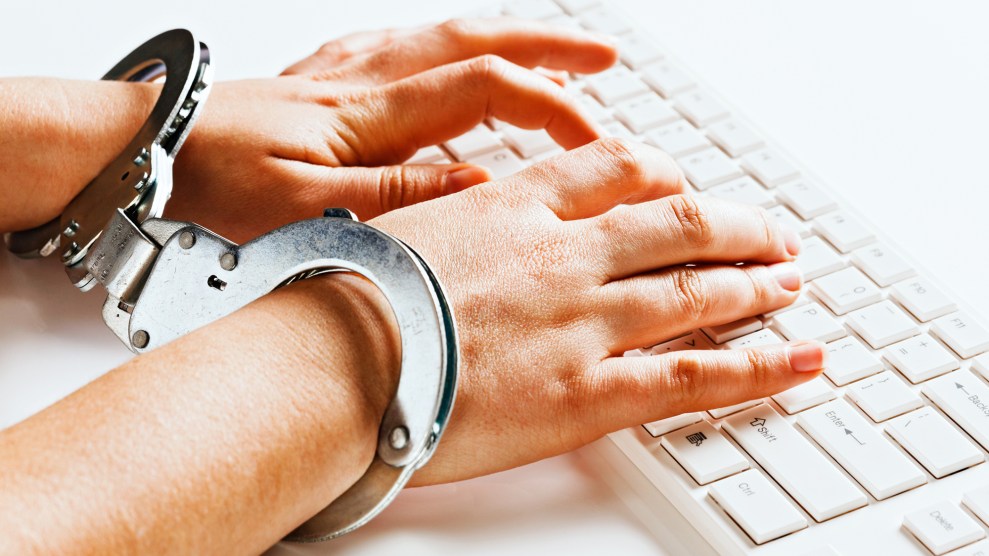
Trump has called for the loosening of libel laws and jailing of journalists: “Very dishonest people!”
On April 29, the same day as this year’s White House Correspondents’ Dinner (which Trump boycotted), the president held a rally in Pennsylvania to commemorate his first 100 days. He spent his first 10 minutes or so attacking the media: CNN and MSNBC were “fake news.” The “totally failing New York Times” was getting “smaller and smaller,” now operating out of “a very ugly office building in a very crummy location.” Trump went on: “If the media’s job is to be honest and tell the truth, then I think we would all agree the media deserves a very, very big, fat failing grade. [Cheers.] Very dishonest people!”
Trump’s animosity toward the press isn’t limited to rhetoric. His administration has excluded from press briefings reporters who wrote critical stories, and it famously barred American media from his Oval Office meeting with Russia’s foreign minister and ambassador to the United States while inviting in Russia’s state-controlled news service.
Before firing FBI Director James Comey, Trump reportedly urged Comey to jail journalists who published classified information. As a litigious businessman, the president has expressed his desire to “open up” libel laws. In April, White House chief of staff Reince Preibus acknowledged that the administration had indeed examined its options on that front.
This behavior seems to be having a ripple effect: On May 9, a journalist was arrested in West Virginia for repeatedly asking a question that Tom Price, Trump’s health secretary, refused to answer. Nine days later, a veteran reporter was manhandled and roughly escorted out of a federal building after he tried (politely) to question an FCC commissioner. Montana Republican Greg Gianforte won a seat in the House of Representatives last week, one day after he was charged with assaulting a reporter who had pressed Gianforte for his take on the House health care bill. And over the long weekend, although it could be a coincidence, someone fired a gun of some sort at the offices of the Lexington Herald-Leader, a paper singled out days earlier by Kentucky Gov. Matt Bevin, who likened journalists to “cicadas” who “don’t actually seem to care about Kentucky.”
Where is all of this headed? It’s hard to know for sure, but as a lawyer (and former newspaper reporter) who has spent years defending press freedoms in America, I can say with some confidence that the First Amendment will soon be tested in ways we haven’t seen before. Let’s look at three key areas that First Amendment watchdogs are monitoring with trepidation.
Abusive Subpoenas
The First Amendment offers limited protections when a prosecutor or a civil litigant subpoenas a journalist in the hope of obtaining confidential notes and sources. In the 1972 case of Branzburg v. Hayes, a deeply divided Supreme Court ruled that the Constitution does not shield reporters from the obligation of complying with a grand jury subpoena. But the decision left room for the protection of journalists who refuse to burn a source in other contexts—in civil cases, for instance, or in criminal cases that don’t involve a grand jury. Some lower courts have ruled that the First Amendment indeed provides such protections.
Unlike most states, Congress has refused to pass a law protecting journalists who won’t burn their confidential sources.
The Constitution, of course, is merely a baseline for civil liberties. Recognizing the gap left by the Branzburg ruling, a majority of the states have enacted shield laws that give journalists protections that Branzburg held were not granted by the Constitution. Yet Congress, despite repeated efforts, has refused to pass such a law. This gives litigants in federal court, including prosecutors, significant leverage to force journalists into compliance. (In 2005, Judith Miller, then of the New York Times, spent 85 days in jail for refusing to reveal her secret source to a federal grand jury investigating the outing of Valerie Plame as a CIA agent. The source, Miller eventually admitted, was Vice President Dick Cheney’s chief of staff, I. Lewis “Scooter” Libby.)
Trump will almost certainly take advantage of his leverage. He and his innermost circle have already demonstrated that they either fail to understand or fail to respect (or both) America’s long-standing tradition of restraint when it comes to a free press. During the campaign, Trump tweeted that Americans who burn the flag—a free-speech act explicitly protected by the Supreme Court—should be locked up or stripped of citizenship “perhaps.” In December, after the New York Times published a portion of Trump’s tax returns, former Trump campaign manager Corey Lewandowski declared that executive editor Dean Baquet “should be in jail.”
Trump took over the reins from an executive branch that was arguably harder on the press than any administration in recent history. President Barack Obama oversaw more prosecutions of leakers under the vaguely worded Espionage Act of 1917 than all other presidents combined, and he was more aggressive than most in wrenching confidential information from journalists.
Over the course of two months in 2012, Obama’s Justice Department secretly subpoenaed and seized phone records from more than 100 Associated Press reporters, potentially in violation of the department’s own policies. Thanks to the rampant overclassification of government documents, Obama’s pursuit of whistleblowers meant that even relatively mundane disclosures could have serious, even criminal, consequences for the leaker. Under Obama, McClatchy noted in 2013, “leaks to media are equated with espionage.”
The Obama administration went after leakers with zeal. One can only assume Trump will up the ante.
One can only assume Trump will up the ante. His administration’s calls to find and prosecute leakers grow more strident by the day. He and his surrogates in Congress have repeatedly tried to divert public discussion away from White House-Russia connections and in the direction of the leaks that brought those connections to light. It stands to reason that Trump’s Justice Department will try to obtain the sources, notes, and communication records of journalists on the receiving end of the leaks.
This could already be happening without our knowledge, and that would be a dangerous thing. Under current guidelines, the Justice Department is generally barred from deploying secret subpoenas for journalists’ records—subpoenas whose existence is not revealed to those whose records are sought. But there are exceptions: The attorney general or another “senior official” may approve no-notice subpoenas when alerting the subject would “pose a clear and substantial threat to the integrity of the investigation.”
The guidelines are not legally binding, in any case, so there may be little to prevent Jeff Sessions’ Justice Department from ignoring them or scrapping them entirely. Team Trump has already jettisoned the policies of its predecessors in other departments, and it’s pretty clear how Trump feels about the press.
The use of secret subpoenas against journalists is deeply problematic in a democracy. Their targets lack the knowledge to consult with a lawyer or to contest the subpoena in court. The public, also in the dark, is unable to pressure government officials to prevent them from subjecting reporters to what could be abusive fishing expeditions.
As president, Trump sets the tone for executives, lawmakers, and prosecutors at all levels. We have already seen a “Trump effect” in the abusive treatment of a reporter in the halls of the Federal Communications Commission, the arrest of the reporter in West Virginia, and the attack by Congressman-elect Gianforte.
We are also seeing the Trump effect in state legislatures, where the president’s rants may have contributed to a spate of legislative proposals deeply hostile to free speech, including bills that would essentially authorize police brutality or “unintentional” civilian violence against protesters and make some forms of lawful protest a felony. A leader who normalizes the use of overly broad or abusive subpoenas against journalists could cause damage all across the land.
Espionage Laws
A second area of concern is the Espionage Act of 1917, a law that has been used for nearly a century to prosecute leakers of classified information—from Daniel Ellsburg and Julius and Ethel Rosenberg to Edward Snowden and Chelsea Manning. The government hasn’t ever tried to use it to prosecute the journalists or media organizations that publish the offending leaks—possibly because it was seen as a bad move in a nation that enshrines press protections in its founding document. But free-speech advocates have long been wary of the possibility.
The successful prosecution of a journalist under the Espionage Act seems unlikely—a long string of Supreme Court decisions supports the notion that reporters and news outlets are immune from civil or criminal liability when they publish information of legitimate public interest that was obtained unlawfully by an outside source. “A stranger’s illegal conduct,” the court’s majority opined in the 2001 Bartnicki v. Vopper case, “does not suffice to remove the First Amendment shield about a matter of public concern.” But like any appellate decision, the Bartnicki ruling is based on a specific set of facts. So there are no guarantees here.
Litigious Billionaires
Very, very rich people with grievances against the press are as old as the press itself. But the number of megawealthy Americans has exploded in recent years, as has the number of small, nonprofit, or independent media outlets—many of which lack ready access to legal counsel. In short, billionaires who wish to exact vengeance for unflattering coverage enjoy a target-rich environment.
Win or lose, a billionaire with an ax to grind and a fleet of expensive lawyers can cause enormous damage to a media outlet.
Trump did not create this environment. But from his presidential bully pulpit, he has pushed a narrative that can only fuel the fire. The Trumpian worldview holds that the media deserves to be put in its place; the press is venal, dishonest, and “fake” most of the time. It should be more subject to legal liability so that, in his words, “we can sue them and win lots of money.”
Win or lose, a billionaire with an ax to grind and a fleet of expensive lawyers can cause enormous damage to a media outlet, particularly one with limited means (which, these days, is most media outlets). Some lawsuits by deep-pocketed plaintiffs, like the one filed against Mother Jones by Idaho billionaire Frank VanderSloot (a case I helped defend), are ultimately dismissed by the courts. Others, such as Hulk Hogan’s lawsuit against Gawker Media—funded by Silicon Valley billionaire and Trump adviser Peter Thiel—succeed and put the media outlet out of business. Another recent suit, filed by Las Vegas casino magnate Sheldon Adelson against a Wall Street Journal reporter, ultimately settled.
Regardless of the outcome of such cases, the message to the media is clear: Don’t offend people who have vast resources. Even a frivolous lawsuit can stifle free speech by hitting publishers where it hurts (the wallet) and subjecting them to legal harassment. This is especially so in the 22 states that lack anti-SLAPP statutes—laws that facilitate the rapid dismissal of libel claims without merit.
The VanderSloot lawsuit is instructive. Although a court in Idaho ultimately threw out all the billionaire’s claims against Mother Jones, the process took almost two years. During that time, VanderSloot and Mother Jones engaged in a grueling regimen of coast-to-coast depositions and extensive and costly discovery and legal motions. Along the way, VanderSloot sued a former small-town newspaper reporter and subjected him to 10 hours of depositions, which resulted in the reporter breaking down in tears while VanderSloot, who had flown to Portland for the occasion, looked on. VanderSloot also deposed the journalist’s ex-boyfriend and threatened to sue him until he agreed to recant statements he had made online.
Trump has not brought any libel lawsuits as president—but his wife has.
Victory did not come cheap for Mother Jones: The final tab was about $2.5 million, only part of which was covered by insurance. And because Idaho lacks an anti-SLAPP statute, none of the magazine’s legal costs could be recovered from VanderSloot.
Despite his threats, Trump has not brought any libel lawsuits as president—but his wife has. First lady Melania Trump sued the Daily Mail in February over a story she said portrayed her falsely “as a prostitute.” The Daily Mail retracted the offending article with a statement explaining (a) that the paper did not “intend to state or suggest that Mrs. Trump ever worked as an ‘escort’ or in the sex business,” (b) that the article “stated that there was no support for the allegations,” and (c) that “the point of the article was that these allegations could impact the U.S. presidential election even if they are untrue.”
So which billionaire will be next to sue, and who will the target be? The question looms over America’s media organizations like a dark cloud. That is an unacceptable situation in a nation whose Constitution guarantees “robust, uninhibited and wide-open” discussion of public issues, as Supreme Court Justice William Brennan wrote in the landmark First Amendment case New York Times v. Sullivan.
Trump has yet to act on his most outrageous rhetorical attacks on the media and free speech, but it’s likely only a matter of time. When he does act, it will be important to remember that constitutional protections are quite broad, and that there’s only so much any White House can do to the press without the backing of Congress or the courts. Such cooperation is hardly out of the question, though. Stranger things have already happened in this strangest of political times.
The author’s views do not necessarily reflect those of the First Amendment Coalition‘s board of directors.