Sitting in his metal caravan, where the noisy, old fans fail to keep the heat of the day away, Abu Khamis inhales from his cigarette while gesturing toward a map hung on the wall, demarcating his village’s land. “The world’s attention is now on Gaza, Lebanon, Syria, and America and Iran,” the head of the village’s Bedouin Council says. “The pressure isn’t here anymore.”
His village, the Palestinian community of Khan al-Ahmar, has been fighting the Israeli government’s demolition orders for the past 17 years.
Its residents live in a cluster of condemned shacks perched on dry, dusty hills, running parallel to the desert highway between Jerusalem and Jericho in the Israeli-occupied West Bank. These homes lie directly in the path of the E1 construction project, a series of proposed Israeli settlements that would link occupied East Jerusalem with the existing settlement of Ma’ale Adumim. Should it succeed, the new segregated housing project would create an unbroken line of Israeli territory across the center of the West Bank, effectively severing the region in two and blocking any unified Palestinian territory. Israeli Finance Minister Bezalel Smotrich has publicly boasted that E1 would “permanently bury the idea of a Palestinian state.”
But for that vision to become a reality, Israel must address the persistent thorn in its side of Khan al-Ahmar, home to roughly 200 members of the Jahalin Bedouin community—pastoral shepherds descended from semi-nomadic tribes—and the area’s only elementary school serving Bedouin children.
In 2009, shortly after the school was built, Israeli authorities handed down demolition orders for the village. In response to the order, the residents of Khan al-Ahmar mounted an effective international protest campaign and filed legal petitions challenging their expulsion, eventually becoming one of the few Palestinian communities whose case reached the halls of the Israeli Supreme Court.
Then, in May of 2018, the Israeli judges ruled against the residents, saying the Israeli government could forcibly relocate Khan al-Ahmar to a nearby garbage dump. Hundreds of journalists, activists, and diplomats subsequently poured into the village, drawing headlines around the world. International solidarity activists physically blocked the bulldozers with their bodies. A BBC film crew appeared in the village and interviewed Israeli cabinet ministers about the demolition. The UN officially warned that evicting Khan al-Ahmar’s residents could constitute a war crime, and Israel temporarily put the demolition orders on hold in October 2018.
The situation existed in a state of limbo until May of this year, when Minister Smotrich resurrected demolition orders for Khan-al Ahmar to clear the way for the E1 project. But the response this time was relatively muted. Protests in the village failed to gather the crowds—of other Palestinians, NGOs, and international activists—that they did in the years prior, with many Palestinians expressing defeat as Israel tightens its grip on the West Bank with no end, or help, in sight.
For years, Khan al-Ahmar survived largely because of international scrutiny. Each time demolition appeared imminent, foreign governments warned Israel against carrying it out—reportedly, even the Trump administration opposed demolition in 2019, believing it would be an obstacle to the president’s “Deal of the Century” peace plan for the region.
Experts warn that attention has faded. “The international community, which in the past knew how to pressure Israel to halt the demolition of Khan al-Ahmar, is now doing nothing in the face of widespread ethnic cleansing across the West Bank and the genocide that continues in Gaza,” Yair Dvir, spokesperson for the Israeli human rights group B’tselem, told The Nation.
Residents fear that the waiting may now be over, as Israel moves toward annexation of the West Bank. As attention shifts elsewhere, and violence escalates across the territory, many believe the international pressure that once held off the village’s demolition can no longer be sustained.
“Now,” Abu Khamis tells me, “I am afraid.”
The strip of land targeted by the E1 project is home to one of the West Bank’s largest Bedouin communities, the Jahalin Bedouin. Around 20 of their pastoral villages stretch across this rural desert corridor between Jerusalem and Jericho, of which 18 would be destroyed in this newest settlement project.
The Jahalin tribe was expelled from its ancestral home in the Negev Desert during Israel’s founding in 1948, alongside 750,000 other Palestinians. Following their 1948 exile, the Jahalin Bedouin settled in the West Bank, which was under Jordanian control at the time. When Israel later occupied the West Bank in 1967, the Jahalin Bedouin were pushed into smaller and more concentrated areas, and much of their land was confiscated by the Israeli state.
Today, just beyond the confines of the dusty village, over the hay-filled pens of sheep and goats, the manicured lawns of Israeli settlements dominate the surrounding hilltops. These are the settlements of Ma’ale Adumim and Kfar Adumim, which Israel constructed in the 1970s after seizing thousands of hectares from Palestinian villages and declaring the land to be state property.
In 2024, the UN’s International Court of Justice declared that Israel’s six-decade occupation of the West Bank was illegal and ordered Israeli forces to withdraw and dismantle all settlements in the territory. Instead, settlement building accelerated.
Over the past three years, an unprecedented number of settlers have also set up tents on the barren hillsides to establish outposts—informal, makeshift settlements that are illegal even under Israeli law, and that Israeli politicians occasionally condemn. Following the October 7 attacks, settlers have expanded into Palestinian communities at a record pace, constructing at least 152 new outposts in the last three years.
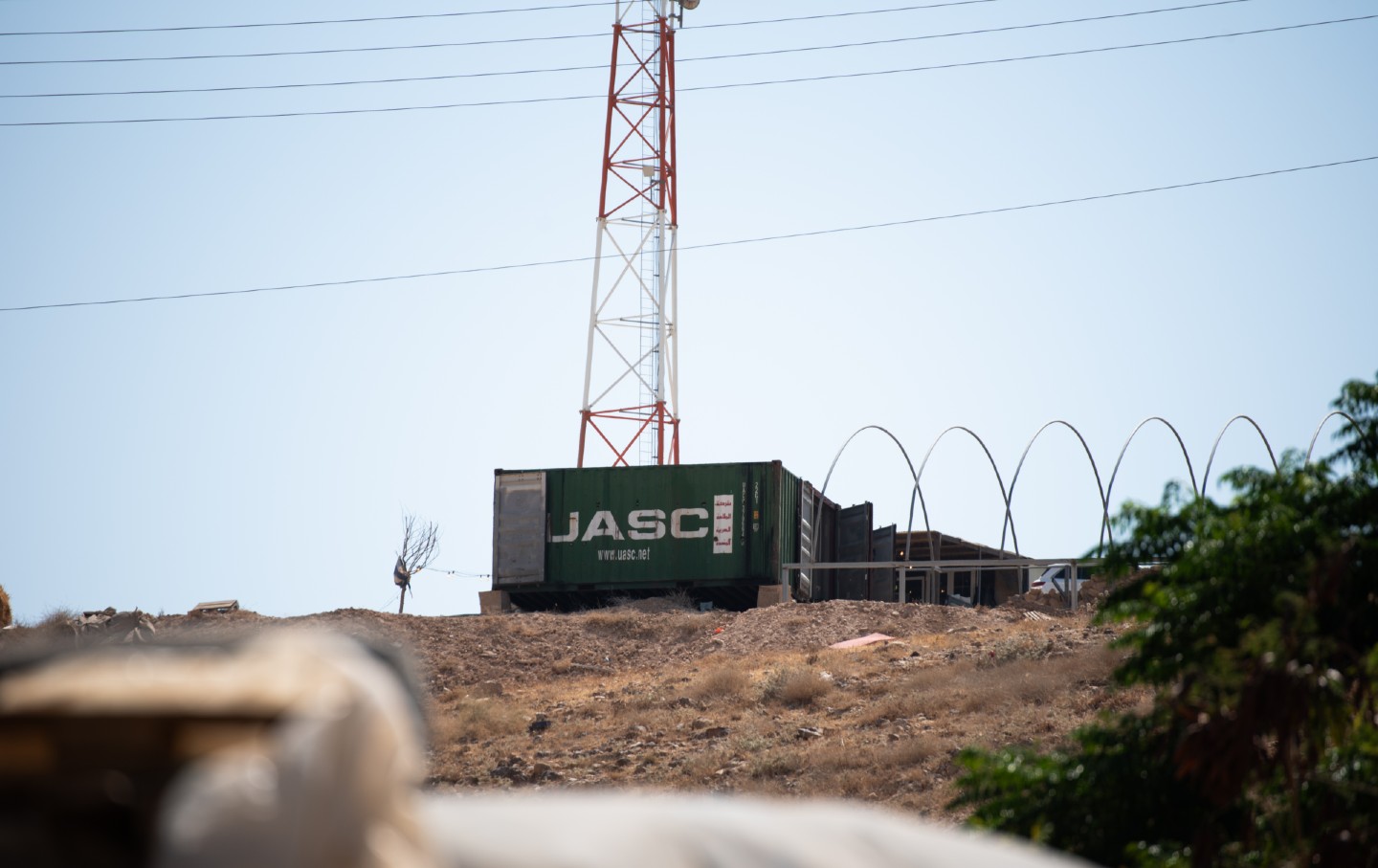
Settlers from illegal outposts are often deeply religious, armed, and violent. The day I arrived in Khan al-Ahmar, a settler from a nearby outpost had run over a 9-year-old, fracturing his arm. Settler violence has become so normalized that the incident passed without much notice. Across the West Bank, the Office of the United Nations High Commissioner for Human Rights has recorded an average of six settler attacks per day in 2026.
“Look what they did,” says an exasperated Abu Khamis, gesturing toward a photo on his phone. The word “revenge” is written in Hebrew across a home of scrap metal, graffiti left behind by settlers during an attack on the village.
Families now must live under the persistent threat of demolition while also contending with violent attacks from a growing settler population, seemingly intent on taking the land by force. “We face pressure from both sides,” says Abu Khamis. “From the settlers on one side and the government on the other.”
Settler attacks increasingly target schools in the occupied West Bank, and the atmosphere at Khan al-Ahmar’s elementary school is on edge. Settlers routinely enter the village, damage its infrastructure, and harass the children.
“The presence of these settlers has impacted the children, especially their emotional state,” says Wa’d al-Khateeb, an English teacher in the elementary school. “The teachers have to look brave for the students, but we’re afraid, too.”
Like most of the teachers in the school, she commutes daily from the city of Ramallah, a journey that can range anywhere from one to five hours each way, depending on the Israeli army checkpoints and the moods of the soldiers. The West Bank road network is highly segregated, with Palestinians restricted from using many of the direct highways—only for Israelis—and forced onto congested backroads crowded with checkpoints.
The school was built precisely to spare children in the surrounding Bedouin communities the risk of navigating these roads. Constructed from mud and recycled tires with support from the Italian NGO Vento di Terra, the school opened in 2009. Today, it is the only elementary school serving Bedouin children in the area.
According to Yusra Jamous, a representative from OHCHR, Smotrich’s latest demolition order now puts the school, which serves approximately 170 students, at immediate risk. “Female students would be particularly affected if the school were demolished,” Jamous told The Nation. “Families often do not allow girls to go to schools out of the area due to fear of settler violence, including sexual violence, and other occupation-related risks on the roads.”
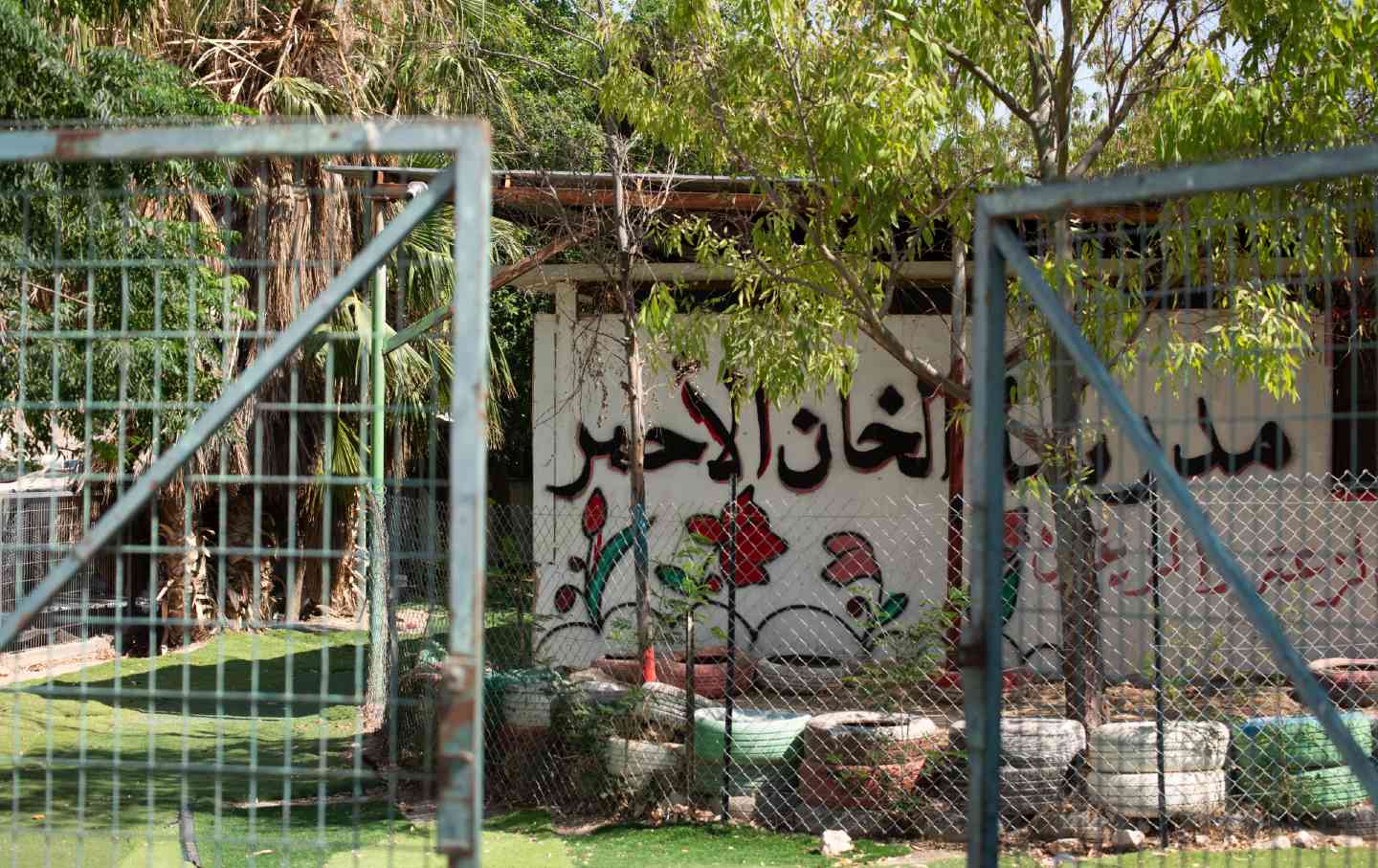
Teachers here are nevertheless attempting to maintain a sense of normalcy for the children. But they face numerous challenges: traumatized students, limited resources, and road closures. To make matters worse, public schools in the West Bank now only operate three days a week, as Israeli authorities withhold $2 billion in tax revenue from the Palestinian Authority, which nominally manages civilian affairs in the West Bank. The PA no longer has enough funds to pay the teachers full-time.
The material conditions have also become near-impossible to work under: Israeli settlers cut the power lines, damage the solar panels, and sabotage the water pumps, says Al-Khateeb. “We have to teach in the dark most days,” she says. And, with temperatures regularly exceeding 105 degrees Fahrenheit, it’s punishingly hot.
“But for us,” she says, “the school represents the children’s right to education and the community’s determination to remain on its land.”
The school’s construction was an act of resistance for the community—and the flash point for Abu Khamis’s activism. When Israeli authorities ordered the work to stop, he says the community found ways to keep building, including dressing some of the foreign volunteers as Bedouins so they could avoid arrest and deportation.
Popular
“swipe left below to view more authors”Swipe →
Shortly after the school was completed, Israel declared it an illegal building and ordered its demolition, saying it—along with other village structures—had been built without permits. Less than 1 percent of Palestinian building permits in Area C of the West Bank, where the village is located, are approved by the Israeli Civil Administration.
In response, Abu Khamis began campaigning against the order and the displacement of the community. By 2012, he was raising the village’s case with international organizations; in 2013, after then-President Barack Obama visited the West Bank, Abu Khamis wrote him a letter making the case for saving his village. He made multiple trips to the United States in 2017 and ’18, meeting with anti-occupation Jewish groups and members of Congress.
He subsequently became the unofficial village spokesman. There have been consequences to such visibility, however. Shortly before our meeting, his 17-year-old daughter was arrested by Israeli authorities, in what he said was without cause and retribution for his activism. He was forced to pay 10,000 shekels, or roughly $3,300, to secure her release.
While advocating for his own community’s survival, Abu Khamis sees a larger picture beyond the displacement of the Bedouins: a decades-old plan for annexation of the West Bank. “People think the settlers are just crazy, but this is the idea since 1967,” he says. “Look where the settlements are built: on the water sources, on the agricultural land, and between Palestinian cities. This is the idea.”
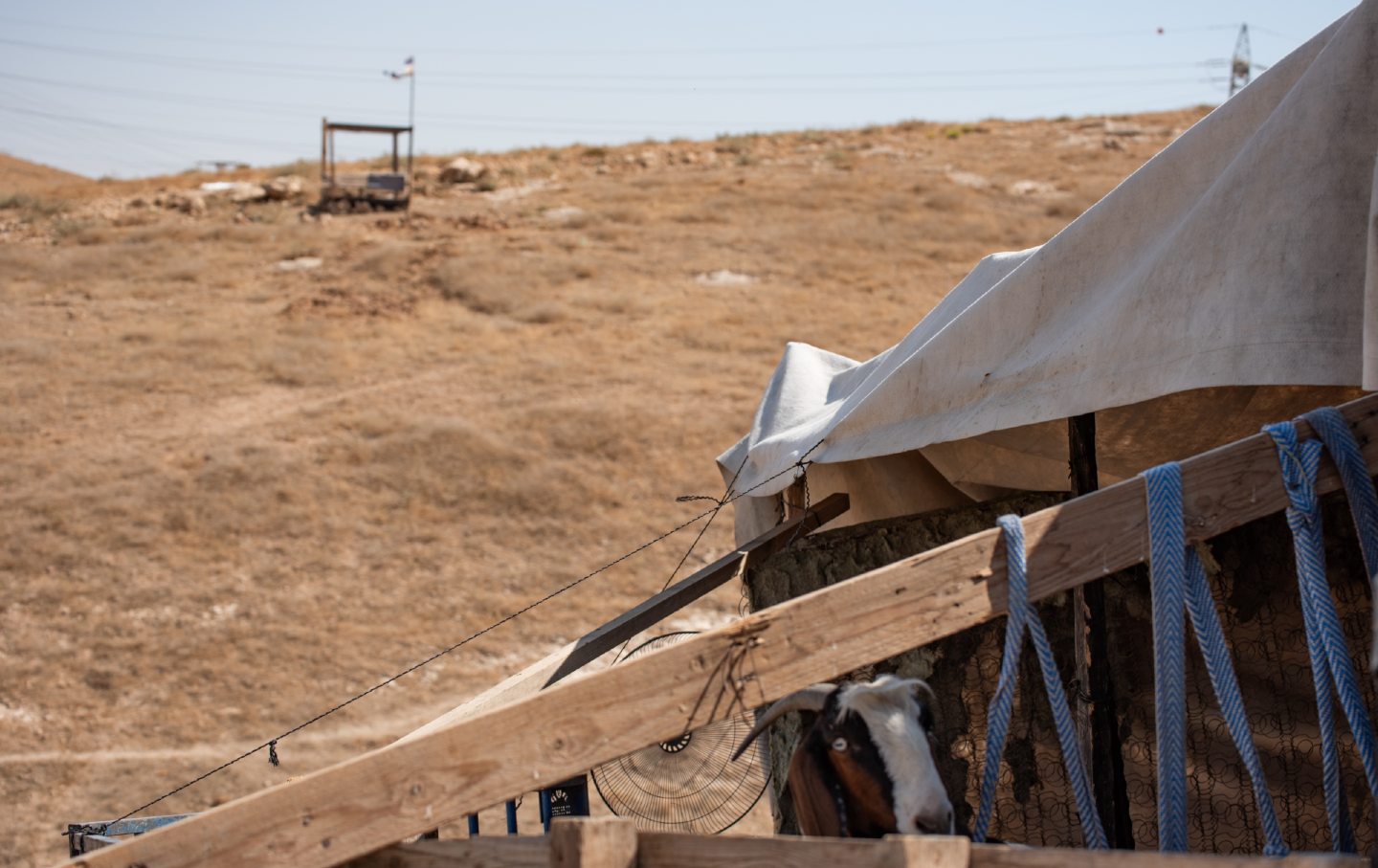
In the last three years, Israeli authorities have demolished at least 66 Palestinian villages in the occupied territory, clearing the way for additional settlements. Many families rendered homeless were forced to move into caves for shelter.
While there has been more international pushback against the E1 plan, with France and the United Kingdom threatening sanctions against companies participating in the project, that pressure has not translated into the kind of spotlight on Khan al-Ahmar that had previously halted demolition attempts. Residents fear the lack of pushback could also set a precedent for the displacement of other Bedouin communities around occupied East Jerusalem, clearing the way for further settlement expansion and the loss of traditional Palestinian pastoralism.
The displacement into urban areas would also force Bedouins, who for centuries have based their livelihoods on herding, to give up their way of life entirely, says Jamous, the OHCHR representative.
Khan al-Ahmar’s pastoral future appears to depend, at least in part, on whether international pressure returns. Without it, residents fear they will follow the path of numerous other Bedouin villages, where families woke to the sounds of army bulldozers and the crumbling of corrugated sheet metal.
“Maybe Smotrich is coming tomorrow,” Abu Khamis says. “Maybe Smotrich is coming in the night. I don’t know when he is coming.”
We look toward a nearby barren hilltop, where an Israeli flag now flaps in the wind. When a group of armed settlers on quad bikes approaches, we hurry back inside the caravan.
There is nothing to do but wait.
More from The Nation
Teaching in the South of France, I learned that equality was just a story teachers told about themselves.
Brianna Di Monda

France’s education system is stretched to its limits, as student anger kicks off a hot fall protest season.
June Loper and Harrison Stetler

Eight years after Armenia’s “Velvet Revolution,” Nikol Pashinyan’s government has deepened the country’s neoliberal trajectory while reorienting Armenia toward the West.
Pietro A. Shakarian
The American action in the contested strait isn’t sustainable—and won’t alter the economic and political fallout from its closure.
David Faris

Sanseitō has attracted young voters through a robust social-media strategy, Charlie Kirk–like public speaking events, and anti-establishment messaging.
StudentNation
/
Sena Chang
In the 1940s, The Nation asked questions about the atomic bomb we’re asking of artificial intelligence today.
Richard Kreitner