Operation Vivaldi, a Ukrainian military effort to repel Russian forces in the Donbas, has done much more than push back Moscow’s offensive in the region. The operation is credited with the liberation of dozens of square miles of once Russian held territory because of its mastermind use of drones and robotics on the battlefield. The operation has also ignited a firestorm of debate over the future of war and the human role. What follows is independent analysis of Operation Vivaldi by two Cipher Brief contributors who are actively engaged in the region.
INDEPENDENT ANALYSIS – Some Western commentators have suggested that Ukraine’s successful limited counteroffensive, Operation Vivaldi, by the 3rd Army Corps (3AC) has demonstrated the continued relevance of human maneuver in the face of drone technology, downplaying the ascendancy of drone warfare. In fact, Operation Vivaldi demonstrates just the opposite: the inexorable erosion of the usefulness of humans in direct contact with the enemy.
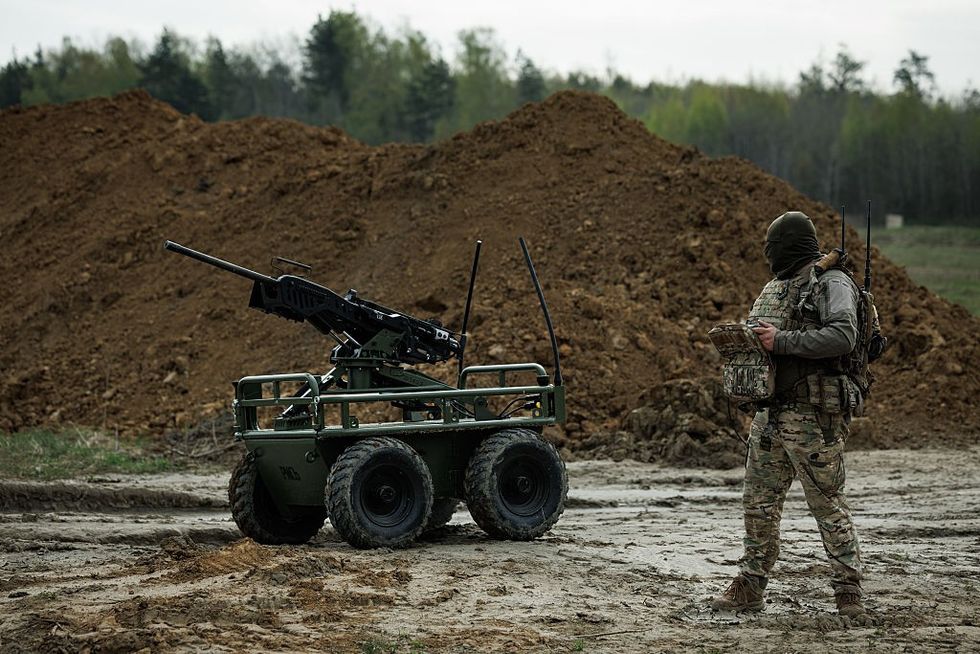
While isolated videos on social media may be found of direct fires exchanged between small elements of humans during the ongoing counteroffensive, the bulk of OSINT footage, as well as comments from Ukrainian commanders and soldiers, indicates that a new, systematic doctrine for the use of UGVs (unmanned ground vehicles) has been critical to operational success, and that humans generally advance only into lower-risk areas in the wake of waves of ground-drone advances.
The key to this doctrine is a fusion of classic American warfighting principles (taught to Ukrainians) with new tactics, techniques, and procedures (TTPs), together with a recognition of the changing spatial dimensions of modern warfare. In Operation Vivaldi, the aforementioned TTPs notably included the use of air-dropped UGVs to strike Russian positions, sow chaos behind enemy lines, take and hold ground, and clear lanes through minefields ahead of human advances.
According to “Darwin,” commander of the 2nd Mechanized Battalion of the 3AC, Russian soldiers and drones were suppressed by artillery, strike drones, and electronic warfare in order to prevent them from noticing night flights of repurposed heavy bomber drones carrying UGVs up to 19 kilometers deep into Russian lines. Some air-dropped UGVs with bombs struck Russian positions, while other UGVs with small arms would take and hold ground, sometimes killing and sometimes capturing the enemy in the process. Only then would humans incrementally advance: “We go forward, making a defense line, then waiting until artillery, flying drones and robots do their work, and then go in again.”
His men still only did this in small groups, with no restoration of large simultaneous human maneuver: “If before we moved with big battalion groups with mechanized forces, now we should use only small groups because of drones.” While this new pattern is currently only reported in use by 3AC, Darwin “said his corps was already teaching it to other brigades,” but noted that it required “a command structure ‘qualified enough as we are’ to run an operation with that many moving parts.”
But Ukraine still needed to degrade Russian operations before attempting to advance. Besides utilizing kinetic strikes, Ukrainian forces also deployed an electronic warfare “curtain” over parts of the battlefield, masking some Ukrainian movements and preventing Russian reconnaissance drones from operating. According to the Third Army Corps, its comprehensive “Defensive Dome” eliminated around 20,000 Russian drones during the operation, including via the use of interceptor drones, freeing Ukrainian armor to conduct mechanized assaults.
“Makar,” commander of the UGV unit “NG13” of the 3rd Separate Assault Brigade of the 3AC, says that air-dropped UGVs were used for months by his unit as “part of a systematic approach to sabotage operations, as such missions are aimed at eliminating the enemy deep behind their lines and in hideouts, capturing enemy pilots, disrupting logistics, and so on.” While the air-dropping technique itself may be a temporary novelty, the systematic large-scale use of UGVs ahead of humans may lead to a situation that he says “changes the rules of war.”
Makar continues: “We are developing a global doctrine for the use of UGVs… by the end of 2026, we’ll carry out a number of crazy operations the world… can’t even imagine are possible.” Regarding the military structure required, he mentions “strong coordination between the units we work with on these missions” and “the work of the workshop, planning group, command staff, and operators on duty.” He also notes the particular usefulness of UGVs–typically equipped with Starlink, hard to notice by the enemy, and not limited by station time like unmanned aerial vehicles (UAVs)–in enemy-held areas “where we have limited observation, limited FPV range, restricted operating distances, or where the enemy has strong air defense teams.”
Russian infantry has seen some success with infiltration tactics, able to slip through gaps in the thin Ukrainian lines singly or in pairs, due to the Russian tolerance for horrific casualties among such drone fodder.
Ukrainian UGVs, which need not be conserved like humans, are now performing similar infiltration missions against the Russians, but at even greater depth and sowing even greater disruption. “A UGV armed with a machine gun is probably more intimidating than an infantryman in many situations,” Obi, a soldier from Ukraine’s 3rd Special Operations Regiment, told the authors.
Makar described how in one episode, a single UGV caused disproportionate chaos: “They were freaking out over the radio, ‘A toy car flew in, then drove around, and then exploded…’ Well, their command doesn’t believe them, all hell breaks loose, and movement along that logistics route is immediately banned. All positions were placed on full combat alert… There were many times when they said, ‘No, we won’t go there because it’s unclear what’s going on there,’ and so on.” In another episode, “a single small UGV, airdropped some distance away, eliminated one enemy soldier and as a result, a full-scale enemy assault they’d been planning for days, if not weeks, was called off.”
Finally, Makar specifically refers to UGVs as a kind of replacement for infantry, saying: “Paratroopers used to drop from planes. Now UGVs are dropped from heavy bombers… I would like to address all the commanders… Emphasize ground robotic complexes… because robots don’t bleed, and human life is priceless.” Still, although they aren’t priceless like humans, drones need protection too: during Operation Vivaldi, relatively expendable UAVs were used to scout ahead of and escort UGVs.
Dmytro, a soldier with Ukraine’s Third Separate Assault Brigade, told the authors that drones and ground robots play a key role in supporting the infantry and also remove humans from some of the most dangerous tasks. “There are also many strike ground robots that drive in and destroy enemy shelters, killing the personnel inside,” he said. Some robots are meant to engage in assault operations, while others are sent behind enemy lines to conduct ambushes.
Additionally, as Ukrainian infantry and drone operators move forward, ground robots handle much of the logistics. “Ground robots make all kinds of deliveries to positions, including supplies for drone crews,” said Dmytro. “They deliver ammunition to artillery positions and supplies to the front line, and they carry out many evacuations.” In fact, 80% of tactical logistics and 90% of casualty evacuations during Operation Vivaldi were done by UGVs.
Former American soldier “Jackie,” who volunteered to serve with and advise 3AC, emphasizes that the American style of warfighting and command culture is critical to the integration of the emerging doctrine and new technologies seen in Operation Vivaldi.
“That’s been my job primarily is installing Western mission command trust and initiative.” Such concepts are embraced by 3AC, but don’t work at all for Russians: “It wouldn’t matter if I gave [them] a perfect lecture on Western Mission Command because they’re asking their guys to go die for nothing constantly… you can’t have initiative and trust in that environment… they misreport and they lie all the time.”
The effective military culture together with scaled drone use has resulted in three Russian field armies being pushed back by the much smaller 3AC, which consistently achieves an astonishingly favorable exchange ratio of 20:1 against the Russians (a claim backed up by OSINT as well as Ukraine’s battle “points” awarded according to provable kills, in which 3AC is usually leading when compared to other Ukrainian units).
Jackie points out, however, that Ukrainians have advanced past legacy doctrine and that Western commanders and planners need a feedback loop with people on the ground to keep up with what’s happening: “We’ve all been doing this for four and a half years. We are super experienced now. The operational planners who did this are elite. Sometimes you get a graduate of some war college somewhere with two pumps in the Middle East that says ‘I know everything about war and the Ukrainians should do this and that’… if you want to learn something by the way you actually have to participate in this fight. And I’m trying to constantly give out calls to Western forces… to come over here and do some work with us.”
“The theory of battle for the Ukrainians is really good. So they have a strategic deep strike campaign that’s punishing the Russian economy. At the operational level we have the midstrike campaign” targeting Russian logistics, “forcing them to have to vacate” their forward positions due to the extension of the gray zone. He adds: “The ground game is really important. If we lose the fortress belt, there will not be time for the midstrike campaign to pull Russians back. There will not be time to continue to do damage on the deep strike campaign and make the political actors in Russia pay.”
One new element of Ukrainian doctrine Jackie mentions is the need for standoff. 3AC maintains “control of ground space that enables us to continue to intercept Russian drones overhead. Russians are not able to get rocket artillery and other mass fires in range of the city of Izium.”
He says, “There is no contact line. There’s like a contact zone and that zone is 30 km across.” He emphasizes that this contact zone or “gray zone” is not a confused or messy jumble on the ground; Ukrainian commanders know where their men are positioned. But in this zone, human maneuver and logistics are severely constrained.
Dmytro said that Ukrainian forces attempted to bypass wooded areas and cut off Russian logistics, instead of sending infantry first. Ukrainian forces also continued shooting down the larger drones the Russians were using for resupply, which had a crippling effect on morale. “The enemy infantry begins to feel that no one needs them and that no help or support is coming,” he said. “Their morale becomes very low, and we make progress. Then they surrender or start fleeing.”
The principle behind the aforementioned infiltration tactics applies also to the enemy’s defense, as Jackie explains: “Where there’s just Russians all over the place that nobody cares about, and clearing them out is a pain… Driving a column across the gray zone is not an option to make an assault. That’s definitely not what we did for Vivaldi. So we had the ground drones on logistics, but also attack ground drones that were being air dropped behind the Russian line and then isolating and either fixing or destroying in many cases those isolated pockets of Russians on defense.”
UGVs are also more effective in this role than UAVs because “The Russians are going to have to fight that drone for a period of time. They’re going to have to resource Russian effectors to support the Russian fight against that drone. So in that local area this is creating … massive chaos for whatever company’s area that drone got dropped into… they’re going to totally miss the infantry assault that’s actually approaching and being shaped towards them… some of those ground drop drones were technically like objectives for assault units to go and support… It gives everybody a lot of confidence on the assault to know that we already have a friendly force in the local area and so everybody gets moving faster as well.”
Jackie says that the soldier’s primary weapon is becoming the drone, and his pistol (secondary weapon) is being replaced by the shotgun for defensive use against drones. Yet he concedes that “there’s only one job in the military and that’s infantry. Nothing has changed about that. For all the drones… [What matters is] the ground game right in front of Kramatorsk and Sloviansk with those infantrymen.” But clearly, from all the other quotes above, we can gather that the nature of the infantryman’s work is rapidly transforming into something entirely different from closing with and destroying other infantry with rifle fire and grenades.Therefore Jackie’s point is taken to be that humans and the ground they occupy remain the ultimate tactical objective of the drones that increasingly occupy the buffer zone between them and the enemy’s forward line of humans.
Applying this notion back to the larger operational concept, we can say that combined unmanned-systems warfare, together with advanced mission command and a proper military culture based on initiative and trust, can allow unmanned systems to maneuver through the enemy’s tactical depth before human forces ever advance into the resultant pre-cleared areas.
Take it from the 3rd Army Corps: “Infantry wins wars, but we protect our infantry, which is why the robots go to the enemy first.”
For deeper dives from Xen, you can follow him on X, Substack, or his personal site.
David Kirichenko is a Ukrainian-American freelance journalist who has been covering Russia’s full-scale war against Ukraine since 2022, and is an associate research fellow at the Henry Jackson Society. He can be found on X: @DVKirichenko.
The Cipher Brief is committed to publishing a range of perspectives on national security issues submitted by deeply experienced national security professionals. Opinions expressed are those of the author and do not represent the views or opinions of The Cipher Brief.
Have a perspective to share based on your experience in the national security field? Send it to Editor@thecipherbrief.com for publication consideration.
Read more expert-driven national security insights, perspective and analysis in The Cipher Brief


